
GAS NITRIDING
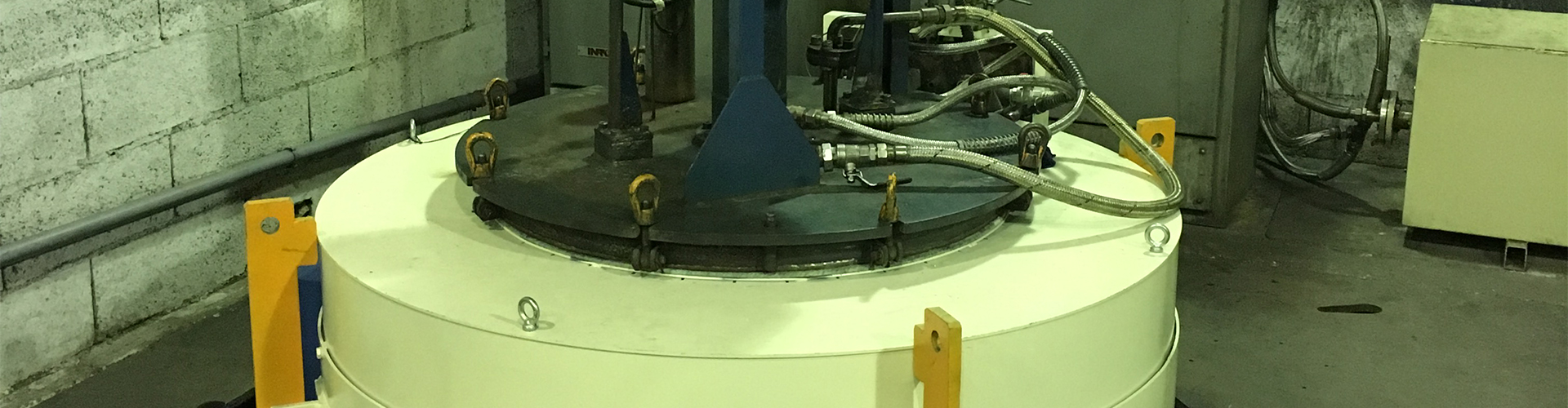
The Eurotechni site located in Nogent offers a gas nitriding service designed to extend the service life of steel parts exposed to wear caused by friction, abrasion, high temperatures and more.
WHAT IS GAS NITRIDING?
Gas nitriding is a surface-hardening process that introduces nitrogen into the surface of a ferrous alloy component. The metal is heated to a specific temperature, generally above 500°C and below the temperature of the final tempering operation. Nitrogen is introduced using a gas, mainly ammonia, which allows it to diffuse into the metal. The diffusion rate and depth depend on the time/temperature combination. Quenching is not required, although nitriding is often combined with tempering as part of a complete heat-treatment process.
Nitriding can cause slight dimensional variations, such as swelling, but these remain relatively limited. It should be noted that all hardening processes cause mechanical distortion.
495–565 °C
Nitriding temperature
NH3
Nitriding gas (ammonia)
Without quenching
Surface hardening
Low distortion
Dimensional variations
The process
A nitriding cycle always follows the same main stages, from component preparation through to controlled cooling.
1
Component preparation
The components must be degreased and cleaned beforehand to ensure optimal treatment results.
2
Furnace loading
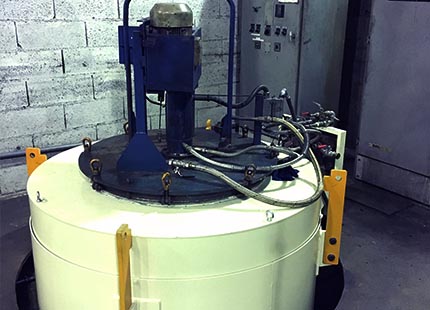
The components are spaced at least a few centimetres apart in a horizontal, pit or bell furnace. A fan circulates the atmosphere so that the gas reaches all surfaces.
3
Furnace purging
The air is purged from the furnace using a neutral or nitriding gas, with at least three times the furnace volume injected.
4
Heating to temperature
The slower the temperature rise, the more uniform the heat distribution and the lower the risk of deformation. Nitriding is carried out between 495 and 565°C, depending on the steel grade.
5
Nitrogen diffusion
At the treatment temperature, the ammonia dissociates at the surface of the steel. The nitriding gas is continuously renewed throughout the cycle to achieve an optimal level of quality.
2 NH₃ → 2 N(Fe) + 3 H₂
Ammonia dissociation at the steel surface
6
Effluent treatment
Hydrogen, nitrogen and residual ammonia are sent to a “cracker”-type pyrolysis furnace heated to over 850°C, then to a flare that ultimately releases only water vapor and nitrogen.
7
Cooling
Cooling is carried out under a neutral or nitriding atmosphere to prevent oxidation and discolouration of the components. Its duration depends on the parameters selected when defining the cycle.
USE OF GAS NITRIDING
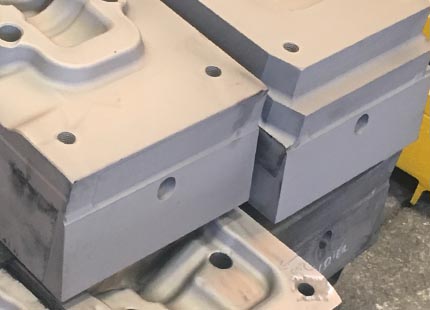
Nitriding is recommended for hot forging tools, such as dies, to increase their service life.
Similarly, steel parts subject to wear caused by friction, abrasion, mechanical stress or heat can benefit from an extended service life thanks to nitriding.
The main advantages of nitriding are:
→ Achieve high surface hardness.
→ Increase wear resistance.
→ Increase service life.
→ Improve corrosion resistance, except on stainless steels.
→ Good dimensional stability.
Featured application:
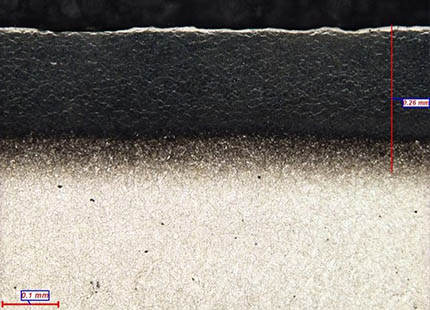
→ Surface hardness achieved: 900 to 1000 HV.
→ Diffusion depth: 0.2 to 0.3 mm.
OUR SERVICES
Pre-treatment surface preparation by shot blasting and/or sandblasting.
Surface hardness testing.
Treatment cycle traceability — continuous data recording.
Protection of specific areas of parts with paint to create masking zones.
Furnace supervision.
Collection and delivery of your parts.
OUR CAPABILITIES
1080 mm
Maximum height.
710 mm
Maximum length & width.
500 kg
Per part — from a few grams up to 500 kg.
3,5 t/j
Treatment capacity.
AVAILABILITY
Nogent (52)
Production site.
7 j/7
Non-stop operation.
36–48 h
Availability of parts.
Our rates for nitriding.
For gas nitriding projects under 10 kg, Eurotechni offers a fixed rate of €50.00.
Above 10 kg, the price per kilo decreases as the total weight increases.
- Between 10 and 25 kg = €6.50/kg.
- Between 25 and 50 kg = €5.50/kg.
- Over 50 kg = €5.00/kg.
For larger projects, we invite you to contact our team, who will prepare a quotation for you.
There is no need to travel: our team can take care of collecting your parts and delivering them back after treatment.
Need to know more ? Let's talk of your project
For over 60 years, Eurotechni has been supporting craftsmen and manufacturers in their projects.
From supplying steel and lubricants to installing automated machinery, our team puts its expertise at your service.
Put your trust in an expert company that is close to its customers and firmly rooted in the heart of the Auvergne-Rhône-Alpes region.
Need information or a quote? Our team is here to advise and support you every step of the way.